GPU Nodes
GPU nodes are only accessible to
shareholders who invested in this type
of resource.
Operational:
| Nodes | GPUs/Node | GPU | GPU-RAM | processing units |
|---|---|---|---|---|
| 4 | 8 | Nvidia Tesla V100 | 16 GB | 5,120 |
| 93 | 8 | Nvidia RTX 2080 Ti | 11 GB | 4,352 |
| 14 | 8 | Nvidia TITAN RTX | 24 GB | 4,608 |
| 16 | 8 | Nvidia Quadro RTX 6000 | 24 GB | 4,608 |
| 33 | 8 | Nvidia RTX 3090 | 24 GB | 10,496 |
| 3 | 8 | Nvidia Tesla A100 | 40 GB | 8,192 |
| 3 | 10 | 80 GB | ||
| 2 | 8 | |||
| 80 | 8 | Nvidia RTX 4090 | 24 GB | 16,384 |
| Nodes | APUs/Node | CPU-Cores/APU | APU | RAM | processing units |
|---|---|---|---|---|---|
| 6 | 4 | 24 | AMD MI300A | 128 GB | 14,592 |
APUs combine CPU cores and GPU
cores on one
die, sharing
common HBM3
memory.
(List is based on 'sinfo -o "%10D %80G %80N')
Decommissioned:
| Nodes | GPUs/Node | GPU | GPU-RAM | Decommissioned in |
|---|---|---|---|---|
| 10 | 8 | Nvidia GTX 1080 | 8 GB | 2023 |
| 50 | 8 | Nvidia GTX 1080 Ti | 11 GB | 2024 |
Specification overview
The capabilities of different GPU models differ quite substantially.
Therefore we provide this overview. For more details, check the sources
of these numbers by clicking the links in the table's header.
Question marks (?) mean that we don't know this value. Dashes (-) mean
that this operation is not provided natively.
Precision |
AMD |
nVidia |
||
|---|---|---|---|---|
Raw |
Tensor Core |
Sparse |
Raw |
Tensor Core |
FP64 https://en.wikipedia.org/wiki/Floating_point_operations_per_second TFLOP/s |
61.3 |
122.6 |
- |
9.7 |
FP32 https://en.wikipedia.org/wiki/Floating_point_operations_per_second TFLOP/s |
122.6 |
122.6 |
- |
19.5 |
FP16 https://en.wikipedia.org/wiki/Floating_point_operations_per_second TFLOP/s |
- |
980.6 |
1'961.2 |
78.0 |
FP8 https://en.wikipedia.org/wiki/Floating_point_operations_per_second TFLOP/s |
- |
1'961.2 |
3'922.3 |
- |
TF32 https://en.wikipedia.org/wiki/Floating_point_operations_per_second TFLOP/s |
- |
490.3 |
980.6 |
- |
BF16 https://en.wikipedia.org/wiki/Floating_point_operations_per_second TFLOP/s |
- |
980.6 |
1'961.2 |
- |
INT32 [TOP/s] |
19.5 |
- |
- |
19.5 |
INT8 [TOP/s] |
? |
1'961.2 |
3'922.3 |
? |
INT4 [TOP/s] |
? |
- |
- |
? |
BOOL [TOP/s] |
? |
- |
- |
? |
Theoretical peak compute
AMD |
nVidia |
nVidia |
nVidia |
|
|---|---|---|---|---|
RAM to GPU [GB/s] |
5’300 |
1’555 |
1’008 |
936 |
GPU to GPU [GB/s] |
256 |
6.25 |
? |
? |
Theoretical peak bandwidth
Benchmarks
To evaluate the performance of our GPUs, we ran several benchmarks. Here's what we measured.
| Application | Hardware | Units | RTX 4090 | A100 | MI300A |
|---|---|---|---|---|---|
| Stream | 1 GPU | [GB/s] | | 927 | | 1'371 | | 2'923 |
| HPL | 1 GPU | https://en.wikipedia.org/wiki/Floating_point_operations_per_second GFLOP/s | | 1'198 | | 14'270 | | 42'800 |
| 4 GPUs | https://en.wikipedia.org/wiki/Floating_point_operations_per_second GFLOP/s | | 4'741 | | 36'850 | | ? | |
| HPCG | 1 GPU | https://en.wikipedia.org/wiki/Floating_point_operations_per_second GFLOP/s | | 188 | | 249 | | 548 |
| 4 GPUs | https://en.wikipedia.org/wiki/Floating_point_operations_per_second GFLOP/s | | 688 | | 891 | | 1'915 | |
| Stream | 1 GPU | [GB/s] | | 927 | | 1'371 | | 2'923 |
| Hashcat MD5 | 4 GPUs | [GH/s] | | 259 | | 184 | | 472 |
STREAM is the de facto industry
standard benchmark for measuring sustained memory bandwidth.
HPL solves a (random) dense
linear system in double precision (64 bits) arithmetic. It is compute
bound.
HPCG uses the conjugate gradient
method to
solve a large sparce linear system benchmark It is I/O
bound.
Hashcat is a password recovery tool and
MD5 is a widely used hash function
producing a 128-bt hash value.
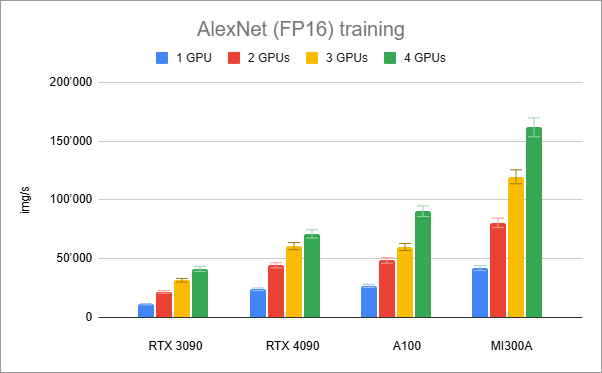
AlexNet
(FP16)
is a neural network for image classification and won
ILSVRC in 2012.
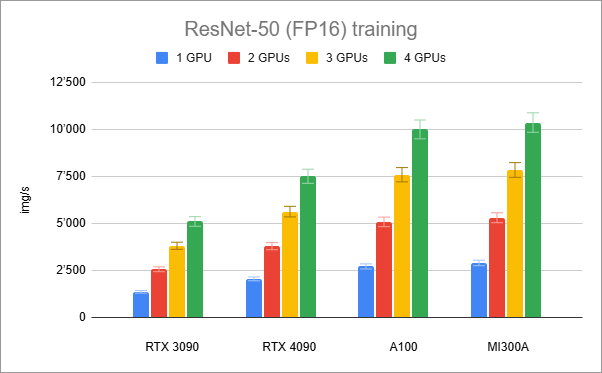
ResNet50
(FP16)
is a neural network for image classification and won
ILSVRC in 2015.
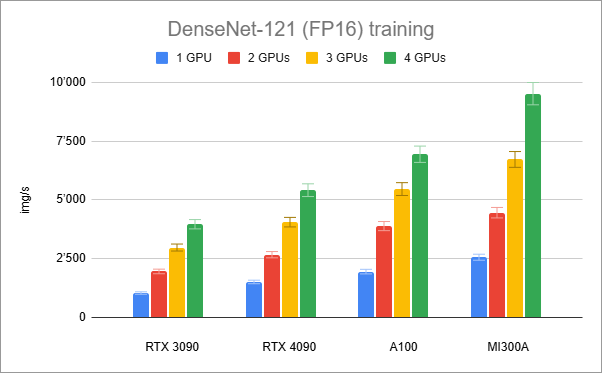
DenseNet-121
(FP16)
is a deep learning architecture designed for image classification and
other tasks like segmentation.